 Share
Share Description
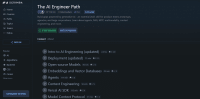
This course is a definitive, career-transforming track designed to propel developers into the most significant technological frontier of our time. As the industry moves beyond simple automation toward complex, agentic systems, this path provides the comprehensive training needed to master the intersection of software engineering and artificial intelligence. Unlike introductory courses that focus solely on prompt engineering, this path dives deep into the architectural "glue" that makes AI applications production-ready. You will learn to transition from a consumer of AI to a creator, building sophisticated systems that can reason, use tools, and process vast amounts of unstructured data. Through hands-on projects, the curriculum guides you through the modern AI stack—from Large Language Models (LLMs) and vector databases to AI orchestration frameworks—ensuring you have the practical skills to build the next generation of intelligent software.
Topics This Course Covers
- LLM Fundamentals & APIs: Mastering the core mechanics of Large Language Models and how to interface with industry leaders like OpenAI, Anthropic, and open-source models.
- Advanced Prompt Engineering: Utilizing sophisticated techniques such as chain-of-thought, few-shot prompting, and iterative refinement to control AI output.
- Vector Databases & Embeddings: Learning how to store and retrieve high-dimensional data using tools like Pinecone or Chroma for long-term AI memory.
- Retrieval-Augmented Generation (RAG): Implementing the RAG pattern to connect LLMs to private data, ensuring accurate and context-aware responses.
- AI Agents & Tool Use: Building autonomous agents that can execute code, search the web, and interact with external APIs to accomplish complex goals.
- AI Orchestration: Getting to grips with frameworks like LangChain or the Vercel AI SDK to manage complex data flows and multi-step AI workflows.
- Image Generation & Vision: Exploring multi-modal capabilities, including generating images and processing visual data using AI.
- Deployment & Scaling: Learning the best practices for deploying AI-native applications to the cloud while managing costs and latency.
Who Will Benefit from This Course
- Frontend & Full-stack Developers: Professionals who want to integrate "smart" features and autonomous agents into their web applications.
- Software Engineers: Individuals looking to future-proof their careers by shifting from traditional logic-based programming to probabilistic, AI-driven engineering.
- Tech Entrepreneurs: Innovators who want to rapidly prototype and launch AI-native products with a deep understanding of the underlying technology.
- CS Students & Graduates: Learners who want to supplement their academic foundation with the specific, high-demand skills currently requested by top-tier tech companies.
- Data Science Enthusiasts: Individuals who want to move from data analysis into the active engineering and deployment of generative AI systems.
Why Take This Course
The role of the "AI Engineer" has emerged as the most sought-after position in the modern tech ecosystem, bridging the gap between theoretical data science and practical product development. Taking this path is an investment in becoming a "T-shaped" developer—one who possesses deep expertise in AI orchestration alongside broad engineering skills. This course is essential because it moves away from "toy" examples and focuses on the real-world challenges of AI, such as managing hallucinations, ensuring data privacy, and optimizing for performance. By mastering the ability to build agentic systems and RAG pipelines, you are acquiring a skill set that is currently in extreme shortage globally. Whether you aim to lead AI initiatives within a major corporation or launch your own AI-first startup, the "AI Engineer Path" provides the technical maturity and portfolio needed to stand at the forefront of the artificial intelligence revolution.