

 Share
Share Description
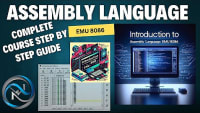
This course on Udemy is an intensive, practical training program designed to teach computer architecture and low-level software development from the ground up. By starting with the fundamentals of microprocessor hardware, this course demystifies how CPUs execute code, manage memory, and interact directly with system resources. Learners begin their journey using emulators like Emu8086 to explore legacy Intel 8086 mechanics—including memory segmentation, registers, and hardware interrupts—before advancing to modern 32-bit and 64-bit x86 architecture using assemblers like NASM. By demonstrating how assembly language bridges high-level code with bare-metal hardware, the course provides a comprehensive hands-on blueprint for writing custom assembly routines and interfacing directly with C programs.
Topics This Course Covers
- Processor Architecture & Registers: Understanding general-purpose registers, temporary storage mechanics, flags, and the instruction execution cycle.
- Legacy 8086 Development & Emulation: Programming the Intel 8086 processor, utilizing Emu8086 to pause execution, inspect memory states, and understand segmentation.
- Interrupts & Memory Segmentation: Executing software interrupts, managing real-mode memory layouts, and controlling hardware routines.
- Stack Operations & Subroutines: Structuring function calls, managing push/pop stack frames, return addresses, and local variables.
- Modern x86 Programming with NASM: Transitioning to modern 32-bit architecture using the NASM Assembler to write stand-alone programs.
- Interfacing Assembly with C Language: Calling C functions from assembly, invoking assembly routines inside C, and accessing arrays, structures, and variables across languages.
Who Will Benefit Taking This Course
- Software Engineers & C/C++ Developers who want to understand how compilers translate source code into machine instructions to write more optimized software.
- Cybersecurity Enthusiasts & Reverse Engineers looking to build essential low-level skills required for binary exploitation, malware analysis, and code auditing.
- Computer Science Students & Hardware Hobbyists seeking a deep, foundational understanding of how microprocessors, memory, and operating systems interact.
- Embedded Systems Programmers aiming to gain precise control over hardware execution, register allocation, and bare-metal performance.
Why Take This Course
High-level programming languages abstract away the internal mechanics of computer hardware, leaving many developers without a clear picture of how programs execute on a physical processor. Learning x86 assembly language removes this abstraction layer, giving you total insight into CPU architecture, memory management, and compiler output. Taking this course equips you with a master-level understanding of hardware execution by combining historical architectural concepts with modern programming techniques. By mastering register manipulation, debugging disassembled code, and seamlessly linking C programs with custom assembly routines, you build a powerful skill set that enhances your capabilities in software optimization, security research, and systems-level engineering.